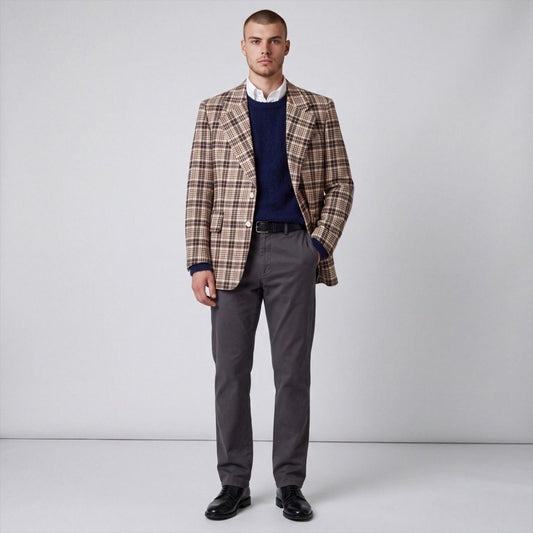
Glen Checks vs. Glen Plaids vs. Prince of Wales Checks: The Ultimate Guide to Menswear’s Iconic Grid
If you have spent any time browsing tailored menswear, heritage sport coats, or vintage Ivy style, you have undoubtedly run headfirst into a trio of terms used almost entirely interchangeably by modern clothing brands: Glen Check, Glen Plaid, and the Prince of Wales Check.
To the uninitiated, they all look like the same handsome, multi-toned box pattern. But to the discerning eye—these patterns carry distinct visual rules, separate histories, and entirely different styling expressions.

Whether you are looking to purchase your first vintage sack jacket or trying to figure out how to break a patterned suit into versatile separates, this guide breaks down the grids, clarifies the terminology, and answers the internet's most pressing questions.
The Baseline Matrix: What Is a Glen Check?
To understand any of these variations, you have to start with the foundational architecture: the Glenurquhart Check (shortened over the decades to simply Glen Check).
The Anatomy of the Weave
A genuine Glen Check is not a printed pattern; it is a complex, woven textile structure. It relies on a specific sequence of dark and light warp and weft threads running through a traditional twill weave. This creates an alternating grid where blocks of micro-sized puppytooth or houndstooth transition into fine, linear blocks of basic twill lines.
The Origin
The pattern originated in the early 19th century in the rugged Glenurquhart valley of Inverness-shire, Scotland. It was initially designed as a "District Check" to outfit the local gamekeepers and estate workers. Because these workers did not belong to a specific Highland clan, the District Checks served as a regional uniform rather than a family tartan.
The Identification Rule: A standard, pure Glen Check is strictly monochromatic or dual-toned—traditionally utilizing black and white, charcoal and grey, or simple earth tones—with zero additional color tracking through the grid.
FAQ: Is It Glen Plaid or Prince of Wales Check?
This is where the terminology splits across the Atlantic.
- Glen Plaid is the popularized American term. During the mid-century Ivy League clothing boom, American makers like Brooks Brothers and J. Press heavily adopted the Scottish fabric. Because the American lexicon historically uses "plaid" to describe any large, checkered pattern, the traditional Scottish Glen Check became permanently rebranded in the States as Glen Plaid.
- Prince of Wales Check, however, is a very specific royal upgrade.
The Royal Distinction: The True Prince of Wales Check
Every Prince of Wales check is built on a Glen Plaid matrix, but not every Glen Plaid is a Prince of Wales check. The pattern earned its royal moniker courtesy of Edward VII (and later cemented by his grandson, Edward VIII, the Duke of Windsor) during his time as the Prince of Wales. While hunting on estates in Scotland, Edward fell in love with the local Glenurquhart check but wanted to customize it to separate his personal guard from the local workers.
He scaled the pattern down slightly and superimposed a colored overcheck—a fine, large windowpane grid—directly over the top of the existing houndstooth matrix.
The Identification Rule: If the pattern consists only of the alternating grey/black houndstooth grid, it is a Glen Check/Glen Plaid. The second a fine, contrasting colored line (traditionally sky blue, rust orange, or soft crimson) tracks through that grid, it officially becomes a Prince of Wales Check.
Answering the Web: People Also Ask
To clear up the confusion floating around modern menswear forums, let's address the most common technical questions directly.
Is Glen Check a Vintage Pattern?
Yes and no. While its architectural DNA dates back to 1840s Scotland, it is more accurately classified as a timeless classic rather than a passing vintage trend. It has experienced distinct historical peaks—most notably the 1930s cinematic era, the 1960s "Mad Men" sharp-tailoring wave, and the mid-century American Ivy Prep movement—but it has never actually left the gentleman’s wardrobe. Buying a vintage Glen Plaid sport coat isn't buying a costume piece; it's buying permanent style infrastructure.
Is Glen Check in Style Now?
Absolutely. In the current menswear landscape, the pattern is experiencing a massive resurgence driven by a shift toward highly texturized, relaxed tailoring. As modern wardrobes lean away from stiff, solid corporate uniforms, guys are utilizing texturized hopsack, linen, and wool-flannel Glen Plaids to bridge the gap between casual environments and sharp presentation.
The Haberdasher’s Guide: Blueprint for the Modern Separate
The single biggest trap a man faces with an estate plaid is the "Accidental Separate" look. If you wear a fine, smooth worsted wool Prince of Wales jacket with a pair of generic grey trousers, you don’t look casual—you look like you accidentally spilled coffee on your suit pants and had to borrow a mismatched pair from a coworker.
To break these patterns away from corporate stiffness and pull them into a rugged, intentional Ivy League rotation, you have to follow three non-negotiable rules:
1. Step-Up the Texture
The fabric texture is what signals that a jacket was built to be worn as a standalone separate. Look for Glen Plaids and Prince of Wales checks woven in matte, substantial cloths—think heavy woolen flannel, texturized seasonal tweed, or open-weave linen-wool hopsacks. A rougher finish immediately dials down the formality and pairs naturally with casual layers.
2. The High-Contrast Anchor
Never wear trousers that are close in tone to the base grey of your jacket. You want unmistakable, high-contrast separation. Ground the lower half of your outfit with substantial materials that have their own weight:
- The Academic Vibe: Pair a monochromatic Glen Check with rich olive-drab chinos or heavyweight wide-wale corduroys.
- The Weekend Casual: Drop a blue-overcheck Prince of Wales jacket over premium, dark indigo raw denim.
- The Classic Trad: Anchor the look with heavy charcoal cavalry twill trousers.
3. Subdue the Shirt and Tie
Because the grid pattern on your jacket is already doing the visual heavy lifting, everything framing your face needs to be a calm, solid canvas. This is where your foundational wardrobe work shines:
- The Shirt: Stick to a thick, heavily texturized Oxford Cloth Button-Down (OCBD) in solid cream, white, or light blue.
- The Neckwear: If you’re wearing a tie, avoid silk foulards or shiny prints. Opt for a matte black or burgundy silk knit tie, or a rugged wool-mohair blend. The matte texture keeps the ensemble grounded in heritage, not the boardroom.

Why Glen Check Works So Well in Secondhand Menswear
Few textile patterns hold their structural integrity and style relevance quite like the Glenurquhart grid.
Unlike modern micro-patterns or trend-driven fast-fashion designs that can quickly feel dated, a traditional Glen Plaid or Prince of Wales check stays permanently relevant because it occupies the ultimate sweet spot between visual complexity and classic restraint.
Furthermore, the physical construction of these garments makes them a premier target when shopping the secondhand market:
- Pattern Camouflage: The intricate, multi-tonal nesting of the houndstooth and windowpane grids is incredibly forgiving. Minor signs of superficial wear or tiny vintage flaws are naturally obscured by the visual depth of the weave, keeping the jacket looking clean and crisp.
- Heritage Fabric Longevity: Classic iterations are frequently found in substantial, premium compositions—such as heavy woolen flannel, crisp worsted wool, or texturized tweed—crafted by legendary vintage makers like Brooks Brothers, J. Press, or Southwick. These fabrics were built to drape beautifully and withstand decades of wear.
- Built-In Provenance: Buying a vintage Glen Plaid sport coat guarantees you are getting the authentic silhouette and fabric weight that defined mid-century Ivy Style, a level of character that modern reproductions rarely replicate.
For the discerning collector, a vintage Prince of Wales or Glen Check sport coat isn't just an eco-friendly wardrobe addition—it represents one of the smartest, highest-value investments you can make in timeless tailoring.
Final Thoughts
While modern retailers will continue to blur the lines between Glen Check, Glen Plaid, and Prince of Wales Check, understanding the true anatomy of these patterns allows you to build your wardrobe with genuine intention. Whether it is the stark, dual-tone versatility of a standard Glen Check or the regal, colored accent of a true Prince of Wales windowpane, these estate plaids remain the absolute gold standard for breaking up rigid suiting and elevating casual ensembles.
The beauty of the pattern lies in its transition. It honors two centuries of rugged Scottish heritage while adapting effortlessly to the relaxed, textured needs of the modern gentleman's rotation. Find the right fit, dial up the contrast in your separates, and let the grid do the heavy lifting for you.
Are You Ready to Shop?
Ready to add this enduring piece of Scottish heritage to your rotation? Browse our meticulously curated, one-of-one selections in The Glen Check & Glen Plaid Jacket Shop to find your perfect vintage match.