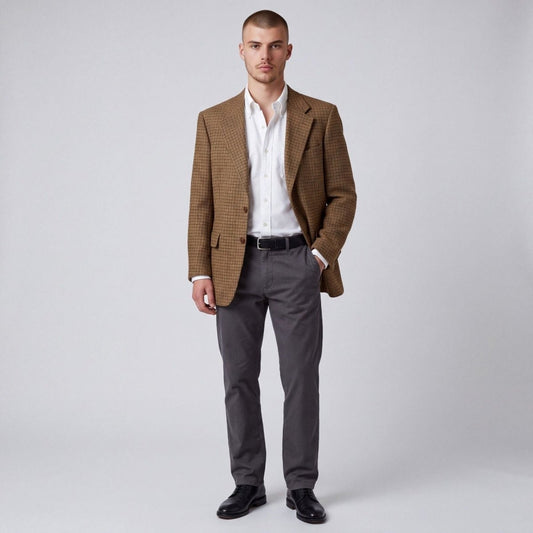
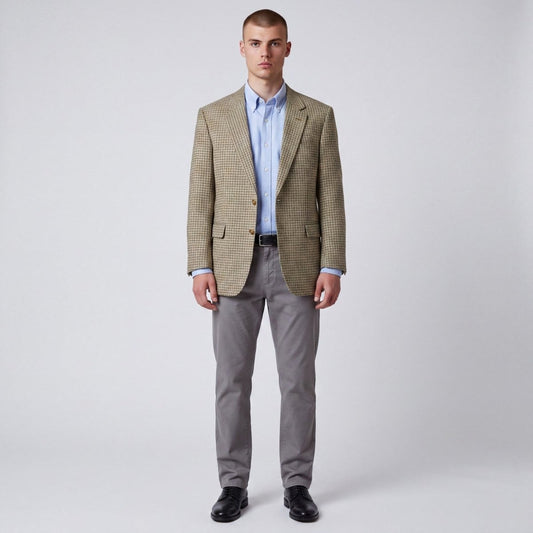
What Is a Gun Club Check? A Guide to One of Menswear's Most Versatile Sport Coat Patterns
Most men can identify a plaid sport coat or a houndstooth jacket at a glance, but far fewer recognize the gun club check pattern. Despite its relatively obscure name, the gun club check has been a staple of classic menswear for decades and remains one of the most versatile patterns available for sport coats, blazers, and tweed jackets.
Known for its rich earth tones, subtle texture, and sporting heritage, the gun check pattern—often worn as a classic gun check sport coat—strikes a balance between visual interest and versatility. Whether you're building a business casual wardrobe, embracing Ivy style, or shopping secondhand for quality tailoring, understanding this classic pattern can help you make more informed menswear decisions.
What Is a Gun Club Check Pattern & Fabric?
The gun club check traces its roots to British country clothing and the sporting traditions of the late nineteenth and early twentieth centuries. Originally associated with hunting, shooting, and other outdoor pursuits, the pattern was designed to blend practicality with understated style.
Traditional gun club check fabrics typically combine several earth-tone colors—often brown, tan, olive, rust, burgundy, or gold—woven together into a small repeating check. Unlike bold plaids or windowpane patterns, gun club checks tend to appear textured and subtle from a distance while revealing greater complexity up close.
Today, the pattern is most commonly found in sport coats and tweed jackets, though it also appears in trousers, vests, and outerwear. Its versatility has helped it transition from rural sporting attire to a respected staple of classic menswear.
How to Identify a Gun Club Check Pattern
One reason the gun club check can be difficult to identify is that it does not always look exactly the same from one garment to another. However, most examples share several defining characteristics.
Multiple Colors Woven Together
Unlike many houndstooth patterns that rely on two contrasting colors, gun club checks typically incorporate three or more colors. Browns, olives, tans, and rust tones are especially common.
These colors create depth and visual texture without overwhelming the rest of an outfit.
Small Repeating Checks
The pattern itself is generally composed of small repeating checks rather than large squares or dramatic overchecks. From several feet away, many gun club jackets appear almost solid, revealing their pattern only upon closer inspection.
Earth-Tone Palette
The traditional color palette reflects the pattern's sporting heritage. Shades inspired by fields, forests, and countryside landscapes remain common today and contribute significantly to the pattern's versatility.
Most Commonly Found in Wool and Tweed
Although modern variations exist, traditional gun club check fabric is most often associated with wool sport coats and heavy tweed jackets.
Traditional Gun Club Check vs. Gun Club Houndstooth
One of the most confusing aspects of gun club check is that the term is often used to describe two related but distinct pattern styles.
Traditional Gun Club Check
The traditional version features a true checked pattern composed of multiple colors woven into a repeating grid-like design. This is the style most menswear enthusiasts think of when discussing gun club check.
The pattern is balanced, textured, and easy to pair with a wide range of wardrobe staples.
Gun Club Houndstooth
A second variation uses a houndstooth weave as its foundation while incorporating the same earthy color palette and sporting aesthetic associated with traditional gun club check fabrics.
These jackets are frequently described as gun club houndstooth, gun club tweed, or simply gun club check by manufacturers and retailers.
From a distance, the two styles can appear remarkably similar. Up close, however, the houndstooth version reveals the distinctive broken-check shape that defines classic houndstooth patterns.

Why Both Are Called Gun Club
Historically, "gun club" referred less to a specific geometric pattern and more to a category of sporting cloth associated with British country attire.
Because both traditional gun club checks and gun club houndstooth fabrics share similar colors, textures, and heritage, the term has gradually evolved into a broader descriptor rather than a strictly defined weave.
As a result, both interpretations remain common in modern menswear.
Gun Club Check vs. Houndstooth
Although the terms are sometimes used interchangeably, gun club check and houndstooth are not the same thing.
Classic houndstooth is defined by its jagged, broken-check shape and is often woven using two contrasting colors. Black and white remains the most recognizable example, though many modern variations exist.
Traditional gun club check, by contrast, relies on a more balanced checked pattern and typically incorporates multiple colors rather than just two.
The confusion arises because some gun club fabrics are themselves woven using a houndstooth base. In those cases, the fabric technically contains houndstooth while still belonging to the broader family of gun club patterns.
For practical purposes, most menswear enthusiasts use "houndstooth" to describe the weave itself and "gun club" to describe the overall sporting style and color palette.
How to Style a Gun Club Check Sport Coat
One reason gun club check has remained popular for generations is its remarkable versatility. The pattern offers more visual interest than a solid jacket while remaining easy to incorporate into a variety of outfits.
Because gun club check already introduces pattern and texture, it is often best to keep the rest of your outfit relatively simple. Solid Oxford cloth button-down shirts, flannel trousers, chinos, and knitwear allow the jacket to remain the focal point while creating a balanced, cohesive look.
Business Casual
For a classic business casual look, pair a gun club check sport coat with a light blue Oxford cloth button-down shirt, charcoal wool trousers, and brown leather loafers.
The patterned jacket provides personality while the neutral trousers keep the outfit grounded and professional.
Ivy Style
Gun club checks fit naturally within an Ivy-inspired wardrobe.
Try combining the jacket with khaki chinos, an Oxford cloth button-down, a repp tie, and penny loafers. The combination feels timeless and highlights the sporting roots that helped popularize the pattern in American menswear.
Smart Casual
For a more relaxed approach, wear the sport coat with a polo shirt, dark denim, and suede loafers or chukka boots.
This combination works particularly well during spring and fall when a sport coat adds structure without feeling overly formal.
Fall and Winter Layering
The earthy tones found in most gun club fabrics pair exceptionally well with seasonal textures.
Grey flannel trousers, Shetland sweaters, corduroys, and leather boots all complement the pattern naturally. The result is a layered look that feels appropriate for cooler weather while maintaining a refined appearance.
Colors That Pair Well With Gun Club Check
Because most gun club jackets contain several earth-tone colors, they pair especially well with:
- Khaki
- Olive
- Brown
- Grey
- Navy
- Cream
- Burgundy
When in doubt, choose trousers and accessories that pick up one of the secondary colors woven into the jacket. This creates a coordinated outfit without appearing overly matched.
Why Gun Club Check Works So Well in Secondhand Menswear
Few patterns age as gracefully as gun club check.
Unlike trend-driven designs that can quickly feel dated, gun club patterns have remained relevant for decades because they occupy a sweet spot between subtle and distinctive.
The pattern also tends to conceal minor wear better than many solid fabrics, making it particularly appealing when shopping secondhand.
Vintage examples are frequently found in sport coats from makers such as Brooks Brothers, J. Press, Hart Schaffner Marx, and Austin Reed. Many of these garments were built to last and continue to offer exceptional value on the secondhand market.
For buyers interested in timeless style, a well-fitted gun club check sport coat often represents one of the smartest additions to a classic wardrobe.
Browse our curated selection of secondhand and vintage Gun Club Check sport coats and blazers.
Final Thoughts
While it may not be as instantly recognizable as houndstooth or windowpane, the gun club check remains one of the most versatile patterns in menswear. Its combination of texture, earthy colors, and sporting heritage allows it to work across a wide range of outfits, from business casual to Ivy-inspired ensembles.
Whether you're identifying a vintage sport coat, building a more versatile wardrobe, or exploring the world of classic tailoring, understanding the gun club check is a valuable step toward dressing with greater confidence and intention.